


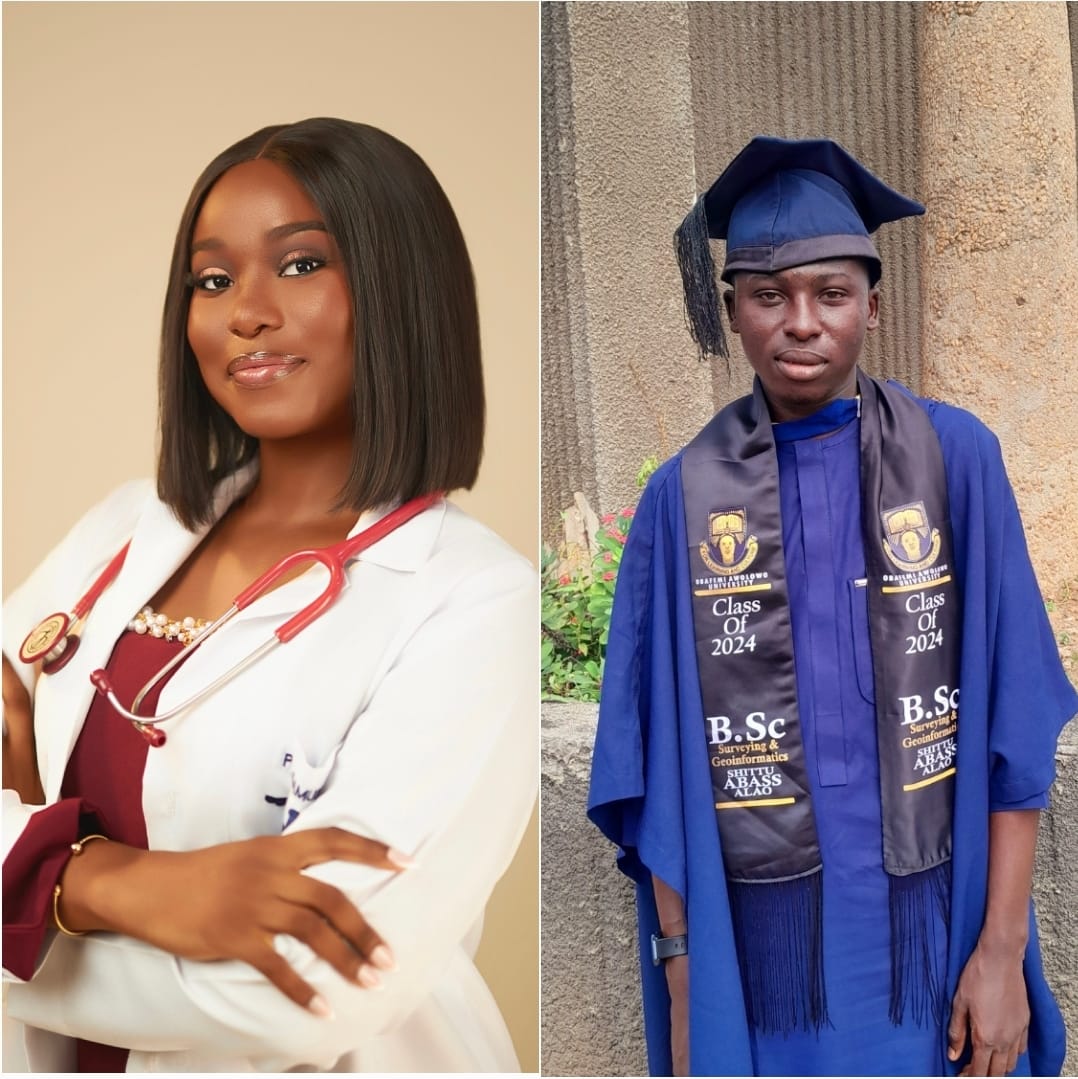
In this interview, two Obafemi Awolowo University (OAU) first-class graduates, Samuel Faith (Medical Rehabilitation/Physiotherapy) and Shittu Abass (Surveying and Geoinformatics), reveal the invaluable strategies that shaped their outstanding academic success, spanning their seven years on campus.
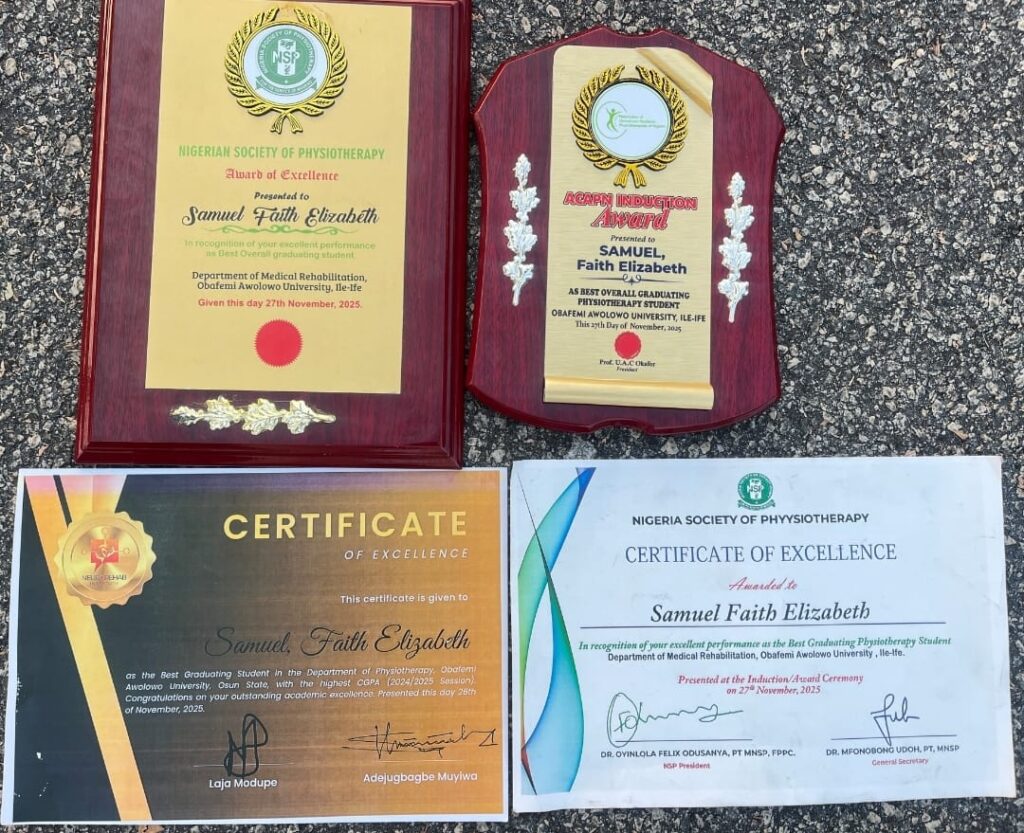
Samuel Faith Elizabeth graduated this year from the department of Medical Rehabilitation (Physiotherapy) with a distinction, setting a record for being the first ever female Best Graduating Student (BGS) to attain such a feat in the department, since its reformation in 2003.
With an impressive Cumulative Grade Point Average (CGPA) of 4.89, the second interviewee, Shittu Abass, graduated as the best student in the department of Surveying and Geoinformatics. He also earned the highest CGPA in the entire Faculty of Environmental Design and Management (EDM) for the 2023/2024 session, making him the faculty’s Best Graduating Student as well.
Revealing their personal practices and offering guidance to undergraduates aiming to attain a corresponding accomplishment, here’s what they both shared about their admirable journeys to earning first-class degrees:
What does your typical study routine look like?
Faith: My typical study routine usually starts around 1- 4 am almost every day, and I study for 4-5 hours or more during the day, depending on how busy the day has been. I try to study for at least 8 hours daily, and for even longer durations during weekends or lecture-free weeks.
Abass: My study routine is very flexible, and for someone with my CGPA, its simplicity would surprise most people. My biggest academic strength at OAU was consistently attending classes. I understand concepts easily during lectures, often beyond the surface, so I never joke about being present. I also made sure I fully understood each day’s lessons before the day ended. I only put in extra study during tests and exams, because most of the real work had already been done through regular class attendance.
READ ALSO: From 1.28 CGPA to 3.61: Damilare Shares His Journey of Resilience and Reinvention
Do you prefer studying alone or in groups?
Faith: I prefer studying alone, or at most with just one other person. Studying in larger groups can create pressure because you might start comparing yourself to others based on their pace, forgetting that everyone absorbs information differently. I absolutely recommend group revision sessions as they can be really helpful for sharpening what you’ve learned or finding out where you are lagging behind.
Abass: I prefer to study alone, and the reason is that I can only assimilate well in an environment with little to no distractions at all, and human faces just happen to be one of the biggest distractions ever for me. So I never did group study, and I mostly would read in my room alone.
How do you manage your time, especially during intense academic periods?
Faith: In times like these, I just really try my best to focus solely on studying, but it can be really challenging.
Abass: Reading was not a thing I did every day. I only did well to attend classes during intense academic periods, and in cases where assignments or assigned school projects felt overwhelming, I would go on campus and stay up with some classmates, at times consecutively for days, to do the assignments and execute the project.
What strategies do you use for preparing for tests and exams?
Faith: I start reading as soon as lectures begin, so the work doesn’t pile up. I also make it a point to study each topic at least twice before revising for exams.
Abass: As I have explained in my study routine section, I would have ensured that I Had understood everything there was to understand before tests and exams and I only would go extra (cramming what needed to be known by heart, forming my thought processes on likely questions, etc) during tests and exams, I never overdid myself during these periods and neither did I ever feel overwhelmed during exams and tests.
How do you handle difficult courses or lecturers?
Faith: I take it to God in prayers o, and also ask my senior colleagues for advice on how they coped with the course or lecturer.
Abass: Looking back, what helped me most was categorising my courses each semester as simple, hard, or non-rewarding. Non-rewarding courses, usually CBTs or courses seniors said didn’t reflect effort, were the ones I did not stress much over. For the hard courses, I focused on understanding the lecturers instead of relying on seniors’ opinions. I attended classes, studied their teaching patterns, and that approach always worked for me.
How do you balance academics with social life, extracurricular activities, or personal commitments?
Faith: There is no real balance, just organised madness, lol. Well, I’m not sure I had a proper social life, because academics were my priority. For me, it was more like a 70:30 ratio, with school taking the larger share.
Abass: I was not really that big on extracurricular activities on campus, but the few ones I participated in, I had no problem balancing them with academic commitments. As I have said earlier, the only academic commitment I needed to do before tests and exams was attending classes, and this, in most cases, did not even take up to 20 hours of my time per week. So, I had no problems at all in this aspect.
Are there any sacrifices you’ve had to make to maintain your grades?
Faith: Yes, definitely. I sacrificed a lot of sleep, outings, and free time just to keep up with my academic goals.
Abass: None that I can remember. While this is not to diminish the place of hard work in achieving academic excellence, my academic journey on the OAU campus is inexplicably (or explicably, for that matter) too easy for me. I appreciate God for this. I never had to make any big sacrifices to achieve what I have achieved in terms of grades.
Who or what inspires you to keep pushing for excellence?
Faith: The verse ‘I can do all things through Christ who strengthens me’ inspires me a lot. My personal goals also keep me going, and seeing the results of my hard work also motivates me. Even on days when I expected more, I was still seeing progress, and that pushed me to keep striving for excellence.
Abass: My biggest inspiration, as I do tell people, was the fear of failure. There is nothing I fear more than failure, and this has been the biggest motivator for me. Failures are in levels, and to put things in perspective, I would count a B grade in a course as a failure, mostly, and so I would do all I had to do to prevent it from happening.
Do you have mentors, study groups, or support networks that contribute to your success?
Faith: Yes! My parents, friends, lecturers and senior colleagues.
Abass: No. But mentors, yes.
What academic resources do you rely on the most?
Faith: Online materials.
Abass: Online resources, mainly.
Have you ever felt overwhelmed or burnt out?
Faith: Yes, I have definitely felt overwhelmed at times. Whenever it happens, I call my parents and talk to them; they always know how to make me feel better. My friends also help a lot. Sometimes I take a short break from reading or watch a quick movie to reset. And most importantly, I just say a few prayers, and that gives me peace.
Abass: No, I never felt overwhelmed by schoolwork.
What was the biggest challenge you faced on this journey, and how did you overcome it?
Faith: My biggest challenge was managing the intense workload without getting overwhelmed. There were times I cried because everything felt like too much, but I overcame it by leaning on God, talking to my parents and friends, and taking intentional breaks when I needed them.
Abass: Seriously, I cannot think of anything that will make it to this list of my biggest challenges on this journey.
What common mistakes do you think students make academically?
Faith: One common mistake I think students make is not figuring out early enough what study method works best for them. Some people try to copy their friends’ reading patterns, forgetting that what works for one person may not work for another. It’s okay to try different approaches, but you need to quickly evaluate whether those methods are actually giving you results.
Abass: I think one common mistake that students make is trying too hard to live other people’s (especially brilliant students’) realities without personalising what works for them.
What advice would you give freshers who want to graduate with first-class honours?
Faith: Put God first. Do not let your books pile up; stay consistent from day one. Get close to your seniors; you can learn a lot from their experiences and avoid the mistakes they made. Make friends with your classmates because you’ll need each other along the way. And have at least one study partner who can act as an accountability partner. Consistency, support, and discipline will take you far.
Abass: Try to first understand what works for you and then be intentional about what class of degree you wish to graduate with and be consistent on its path. Let what drives this yearning and wish be internal (self-motivation) because it doesn’t last if you are doing it for someone else.
What career or plans are your academic achievements helping you build?
Faith: They are helping me build a career where I can practise confidently as a physiotherapist, pursue further studies, and position myself for opportunities both locally and internationally. I want to be excellent at what I do, and this is just the beginning.
Abass: Majorly for now, it is getting an opportunity in one of the graduate school scholarship programs outside the country.