


It was first a sharp ‘pah!’ followed by the acrid smell of burning plastic.
For Ibrahim, it was the sudden silence of a 15-year-old fan — a family heirloom — followed hours later by a blown Laptop charger and extension box. For Sanmi, reading at 4:00 a.m., it was his phone charger dying in the middle of the night. For Balogun Daniel, it was the explosive ‘poof’ of a light bulb, shattering and spraying glass across his room.
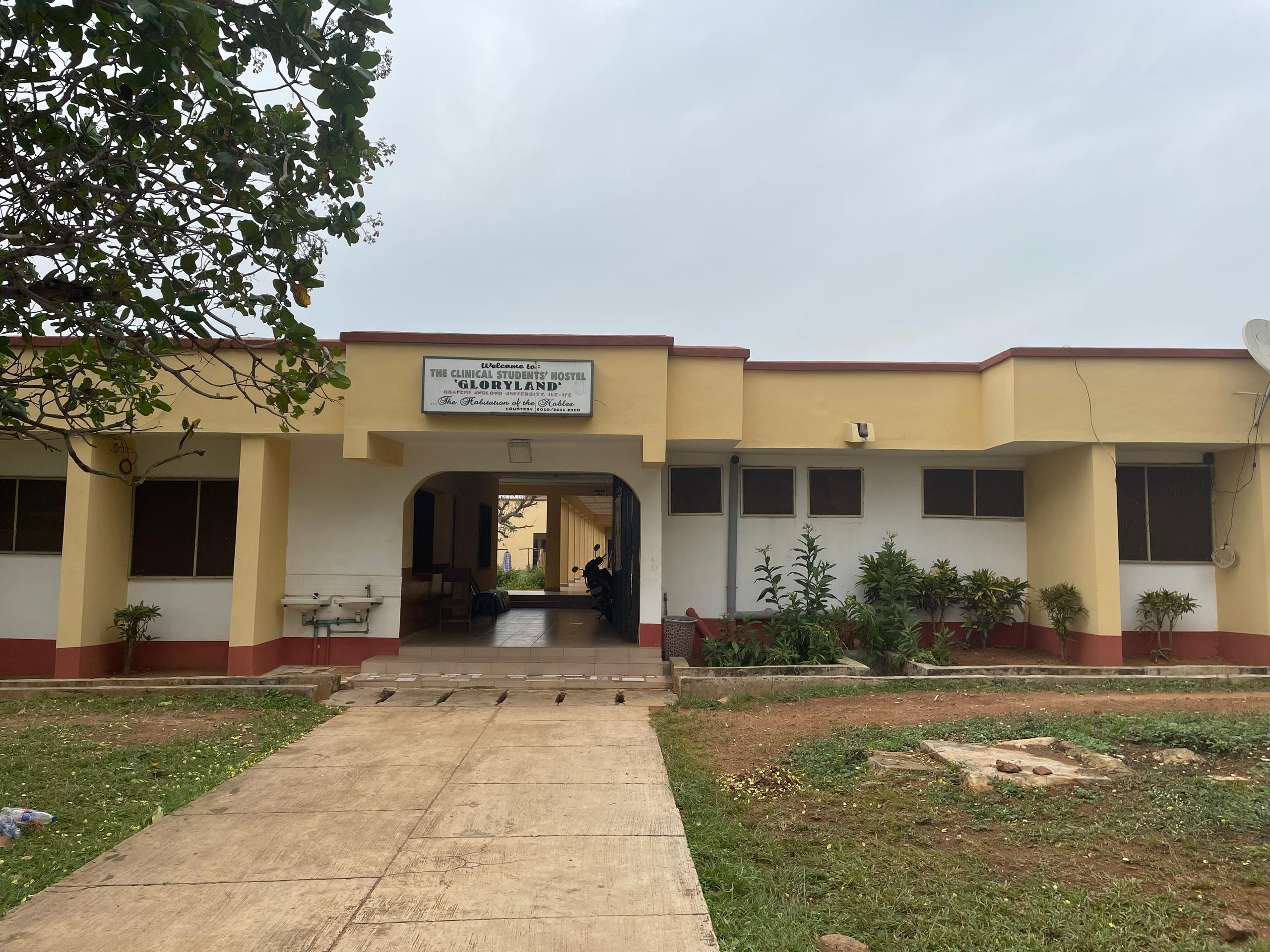
Over two days — Tuesday, January 27, and Wednesday, January 28 — a catastrophic voltage surge ripped through Gloryland Hostel, Obafemi Awolowo University (OAU), Ile-Ife, destroying students’ essential electronics and causing losses conservatively estimated at over ₦180,000, based solely on documented reports.
READ ALSO: 10 Days After Commissioning, CNG Buses, Tricycles Remain Inoperative
When ACJOAU contacted the university’s Works Unit, the explanation raised deeper concerns: Gloryland Hostel draws power from a transformer shared with an off-campus iron-smelting factory, limiting the university’s ability to regulate voltage. The official advice to students for future protection? ‘They can use stabilizers.’
This investigation documents how a known infrastructural vulnerability exposed students to avoidable losses, while responsibility for protection and compensation was quietly shifted onto those already affected.
When the Hum Stopped
The first sign was a silence when there should have been a hum.
In the early hours of Tuesday, January 27, in one of the rooms in Gloryland Hostel, Ile-Ife, Ibrahim* woke to find his fan motionless. Its red power light stared back, a dead eye in the dark. This was no ordinary appliance; it was a piece of family history, handed down by his grandmother from the UK, having survived over a decade and a half of use. In Gloryland Hostel, on that quiet morning, it simply fell silent.
That was the first ominous sign, one he didn’t consider significant at the time.
‘I just felt that, oh, my fan… what is happening? I left it on. I met it off. The red light was on, but I looked at it, and it wasn’t rotating. I was like, ah,’ Ibrahim said.
Having just woken up with sleep in his eyes, Ibrahim was unable to place what had happened. His roommate, who had been awake reading through the night, said the fan had just suddenly stopped working in the middle of the night.
Confused, Ibrahim, a devoted Muslim, set out to pray. At that point, he thought it was a minor technical fault. He carried on with his daily activities in the hope that later, he would just come back, spin it, and get it running again. Or so he thought. When he eventually returned to turn it on, the first shock of the long 48-hour ordeal arrived.
‘I came back, removed it, spin it, spin it. In short, I diagnosed pe kini yi ti lo (the fan had gone),’ Ibrahim recalled with resignation.
He was not the only one, though. Across the hostel, Ibrahim learned other residents had experienced similar spoiling of their electrical gadgets, suggesting that it might have been due to a one-off light disturbance that had seemingly stabilized over the course of the night.
‘So I was like maybe the light…But I felt like it was stable now,’ he said.
But Ibrahim was just about to find out that what he thought was a random, one-off glitch was only the beginning of a stream of losses over the 48 hours. Later that night, as Ibrahim went to sleep, this time without the usual humming and breeze from his fan, little did he know the catastrophe awaiting him.
The Explosion
The next morning, Wednesday, the 28th, Ibrahim woke up early to study on his Laptop, which he charged alongside. When the battery was fully charged, he disconnected the charger from the laptop but left it plugged into the extension.
Around midnight, as Ibrahim worked at his table, the air cracked open. It was the loud, sharp, explosive pop of his socket blowing up, followed by the unmistakable odour of burning plastic and electronics.
‘I was still sitting at my table working… when I heard kpo-pao! And I started smelling barbecue,’ he remarked, recalling the occurrence vividly.
He hurriedly yanked the charger from the extension box, but it was too late. The cycle was complete: he had lost his grandmother’s fan, his laptop charger, and his extension box.
What made it worse was that this was the third fan he had lost within the nearly two years he had spent in the hostel, with the recent losses more like the final nail in the coffin.
‘Gloryland is the common factor with everything,’ he stated, sadness on his face.
Ibrahim was not alone. His tragedy was the opening in a series of sparks and smoke that erupted across Gloryland Hostel that week. While the impact varied, the description was the same for students across the blocks.
A Narrow Escape
Awake between 2:00a.m. and 4:00a.m. on Wednesday, Balogun Daniel was cooking when he heard a ‘poof!’ from across the room. A light bulb in an unoccupied bed space exploded, scattering glass across the floor.
‘I got alarmed, like okay, what happened?’ he recounted. This was his alarm. ‘I quickly took precautions, went to turn off the sockets in the room.’
But it was too late. Curious to see if anything else was affected, he carefully turned one extension back on to test his charger. It didn’t work. His roommate’s charger also didn’t—two chargers, gone in an instant.
‘I got that charger for 7,000 Naira… and it just poof!… I just replaced that bulb like two, three weeks ago… and like that, 1,500 gone,’ he lamented.
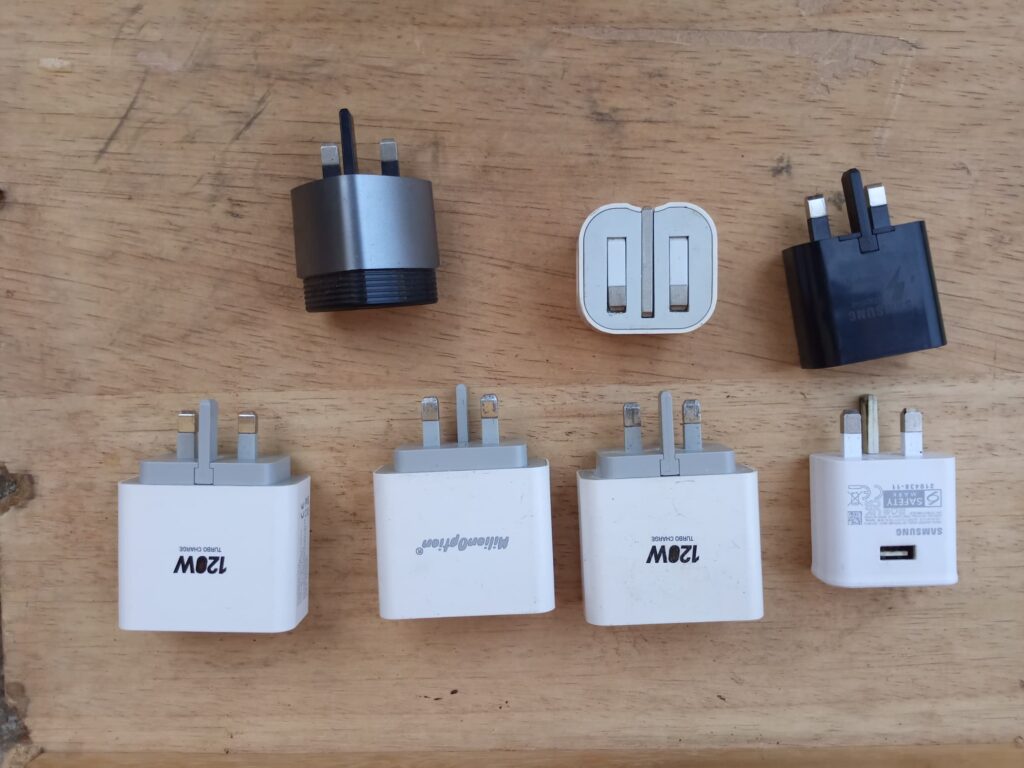
Phone chargers reportedly damaged by the power surge at Gloryland Hostel. Some of the chargers were less than two months old, according to affected students.
Flames During Exam Preparation
On Tuesday morning, Adegbusi Sanmi was reading for his End-of-Posting (EOP) exams in the hostel reading room. Around 4 a.m., the crisis struck at the worst possible hour.
‘Around 4:00 AM… I just heard that ‘pah!’ and I started perceiving a smell,’ he recounted. It was the sound of an explosion from the socket where he plugged in his system to read, followed by the pungent smell of burnt electronics.
His first instinct was to remove the charger, but it was too late. When he tried to plug it in again, he found the charger had spoiled.
‘I felt bad because I am preparing for EOP, so this is not the time for that kind of thing to happen,’ he said. With exams looming, he had no choice but to scrape together funds from an already stretched budget to buy a new charger that same Tuesday.
But the hostel’s electrical system was not done with him. When he plugged in the brand-new replacement on Wednesday afternoon, the horror repeated.
‘Again, I heard another pah!… I saw flame coming from the charger,’ he recounted. He quickly unplugged it from the wall, a miracle that saved him from losing his gadget twice in 24 hours. ‘I just hope that it will continue to work,’ he said, hopeful the new charger would survive the damage it suffered.
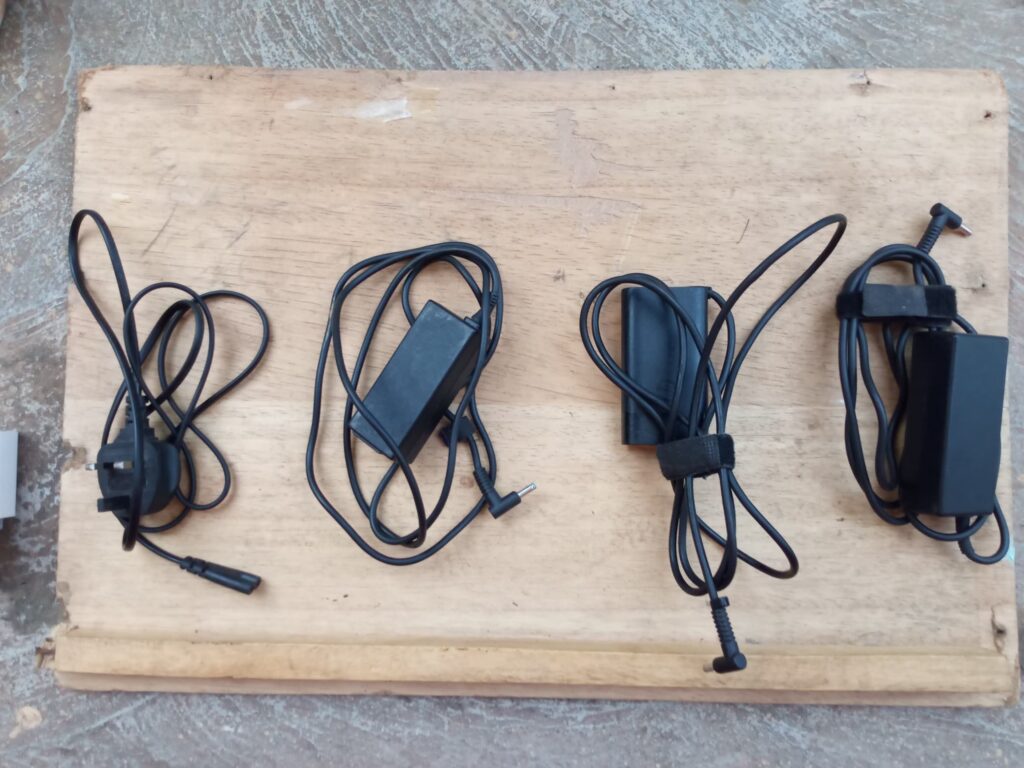
Laptop power cables damaged by the power surge at Gloryland Hostel. Students said the damage occurred while devices were plugged into wall sockets inside their rooms.
Returned to a Lifeless Charger
Around 6:00 a.m. Wednesday, Thompson Godwin plugged his Laptop in to charge before leaving for school. He set out to jog, but when he returned, it was not the usual scent of his room that greeted him, but the faint, familiar, sickening odor of burnt electronics.
‘I am very familiar with the way chargers smell, especially Laptop chargers after they get burnt,’ he said.
His roommate broke the news that there had been a loud sound near the socket and a power surge. “Immediately, I tied the information of what he said and the smell together, and I was like, my charger has probably burnt.”
Godwin’s loss was a Laptop charger he had used for two years. Its death was more than an inconvenience. ‘I could not charge my laptop for days… most of my books are soft copies, so the rate at which I read was significantly reduced.’
In desperation, he began using an incompatible charger, risking permanent damage to his laptop.
The bitter irony was the unused surge protector lying on his table. ‘I just felt, well, it’s just like every other day, and nothing should probably happen,’ he admitted.
Caught Unawares
Olawale Daniel had missed the morning lamentations in the hostel because he woke up late, only to begin rushing for a 9 a.m. class. The only thing he noticed was that there was no water because the pumping machine couldn’t be used due to the ‘bad light.’
Returning exhausted, his phone dead, a fellow resident asked if ‘the light was better now.’ Olawale took it to mean the earlier low voltage had been fixed.
‘I was thinking that, okay, possibly there was no light in the morning, and there was now light,’ he said. He plugged in his brand-new high-speed phone charger, bought less than two months ago.
The response was immediate. ‘It made a ‘pss,’ and then I smelt it. It’s the way you smell your charger, and you know something is wrong.’
His ₦6,000 investment was dead on arrival. The shock was compounded by the discovery that he had walked, uninformed, into a known danger zone. ‘I think maybe much publicity was not done,’ he said dejectedly.
The Numbers Behind the Smoke
To estimate the impact of the incident, ACJOAU circulated a damage assessment form. As responses trickled in, a picture of collective devastation formed across all blocks.
Preliminary survey data captured losses of over ₦180,000, though this excludes the majority of students spoken to in person, whose combined losses would push the total far higher.
Laptop chargers and power adapters damaged during the voltage fluctuation at Gloryland Hostel, OAU. Several students reported losing multiple devices within the same incident.
Mubaraq Ológùnebi was one of the students who responded. For him, it was a total annihilation of his electronic ecosystem. Over 48 hours, he lost an extension box, a ceiling fan, two standing fans, a Laptop adapter, and a phone charger—a total loss he estimated at ₦64,000.
His repair bill was a ledger of despair: ₦12,000 for the ceiling fan, ₦13,000 and ₦18,000 for the standing fans, ₦15,000 for the adapter, and ₦6,000 for the phone charger. “We woke up to discover the damage,” he wrote.
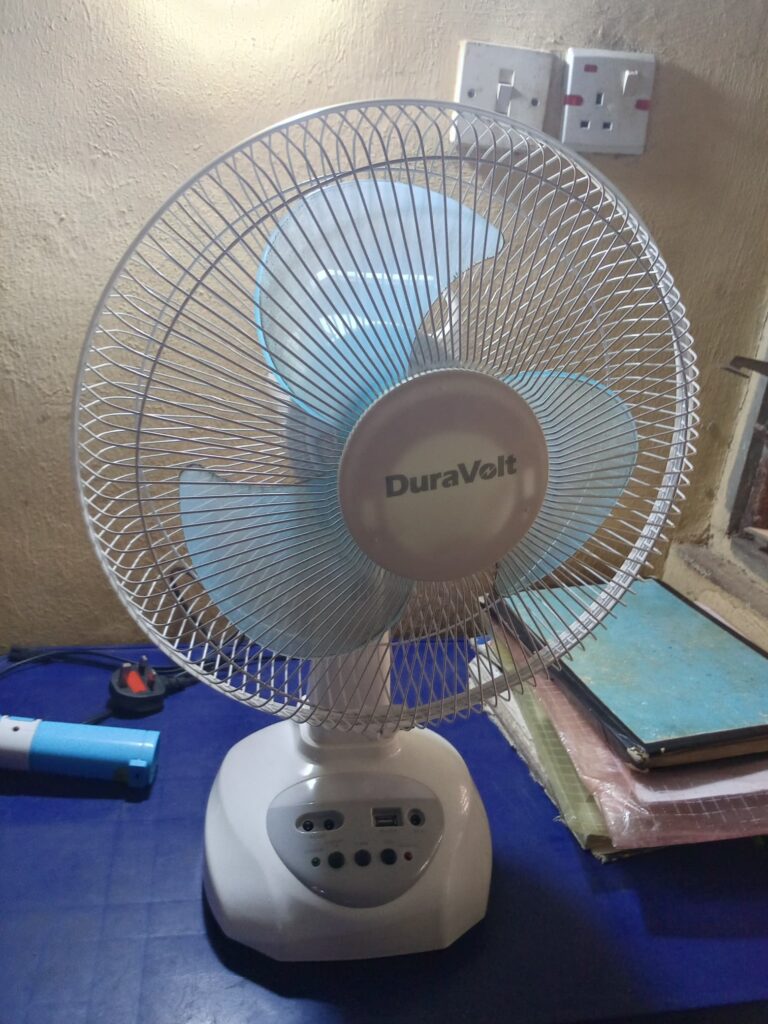
Ezekiel, another resident also lost a ₦45,000 newly bought table fan to the surge on Tuesday. The light flickered about thrice, then there was a pop accompanied with smoke from the bottom of the fan,” he wrote.
Ezekiel’s newly purchased N45,000 standing fan damaged during the power surge at Gloryland Hostel, Obafemi Awolowo University. The appliance had functioned normally before the voltage fluctuation that affected the hostel over two days.
The Night the Grid Went Rogue
Even the Hall Chairman, Toluwalope Faleye, was a victim; his Laptop power cable was fried. Wanting to warn others, he sent a notice to the hostel WhatsApp group, but for many, it was already too late.
When he tried to identify the cause, he found out that the voltage—which should have been a stable 240V—was spiking erratically. ‘That particular day… it was off the roof of 300,’ he recounted.
Alarmed, he alerted the University’s Power Department. The technicians responded within the hour, and by that night, the fluctuations ceased. The immediate fire was out, but the trauma lingered.
When asked if the university could provide reassurance, the Hall Chairman replied bluntly, ‘There’s no reassurance from anybody.’
He highlighted that the cause was “something central” in the power distribution, pointing beyond the hostel walls, and instead advised residents to ‘safeguard your belongings.’
The Shared Transformer
Investigating the cause of the voltage climbing ‘off the roof of 300,’ ACJOAU contacted the University’s Power Department, who responded to halt the voltage fluctuations that day. In a telephone interview, the respondent provided a shocking revelation.
At first, he offered textbook excuses. He explained that power surges can stem from passive natural causes—wind ‘marrying’ lines, falling poles, or frequency fluctuations. While technically accurate, these reasons failed to explain why a catastrophic surge raged repeatedly over 48 hours, specifically within Gloryland Hostel.
With persistent questioning, he finally revealed a shocking truth. The surge had likely originated from the university’s primary power feed at a station at Ajibandale. This transformer, however, does not serve only the university.
‘We share the same transformer with an iron-melting company in town, along Ife-Ibadan Road,’ he explained. Confirmations from ACJOAU indicated that the :iron melting company’ was likely Ife Iron & Steel Nigeria Limited, a steel factory located on the Ife-Ibadan Expressway. This admission was decisive.
This admission was decisive. While an industrial foundry requires high, stable voltage for heavy machinery, a student hostel requires safe, regulated voltage for domestic electronics. A random fault from ‘wind’ could not have explained the scale of destruction reported by students; a shared grid with a volatile industrial load, however, makes the recurring threat an inevitability.
When asked if the feed could be controlled to prevent these surges, his response was a chilling admission of the university’s lack of leverage. ‘They (Ajibandele Power Station) said they cannot regulate it more than that because we are not the only one (using it),’ he said. The reason? Lowering the voltage to safe campus levels could cause ‘energy loss’ for the factory.
Zero Accountability
The instability surging through Gloryland was borne out of a grid where the electrical needs of a foundry and a student hostel are unequally balanced. While the problem is institutional, the university continues to manage the risk at students’ expense.
Despite this systemic failure, when asked what protection existed for students against future occurrences, his response was to the individual rather than the institution. ‘They can use stabilizers,’ he said, suggesting students buy personal stabilizers to protect themselves. He acknowledged the possibility of the university centrally installing ‘high-voltage stabilizers’ to safeguard the entire hostel, but said no such plans exist.
Already struggling with increased fees, students are now being asked to pay for a problem they did not create; not only to replace what was destroyed, but also to pay extra in the hope of preventing the next destruction.
Having traced the fault line from melted chargers to a faraway foundry, a final, unresolved question remains: In a system where the cause is acknowledged but the accountability is diffused, who ultimately bears the cost when the lights betray those they are meant to serve?
NB: * Ibrahim is a pseudonym to keep the respondent anonymous.
In addition, the name of the person who spoke at the Power Department was withheld for anonymity and safety reasons.