


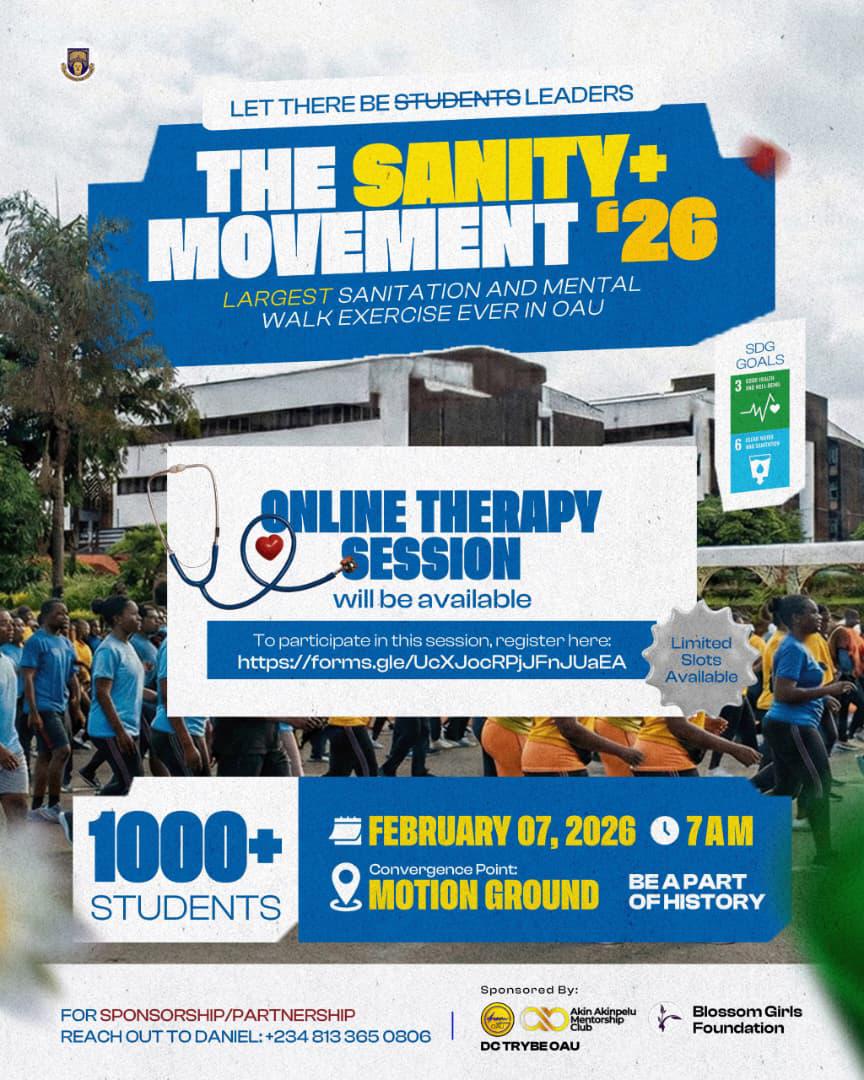
In a powerful blend of advocacy, physical activity, and community consciousness, over 1,000 students of Obafemi Awolowo University (OAU), Ile-Ife, converged early Saturday morning for The Sanity Plus (+) Movement ’26, described as the largest sanitation and mental health walk exercise ever held on campus.
The movement, held on February 7, began at Motion Ground by 7:00 a.m., drawing students from different faculties, halls of residence, and student groups. Branded by the belief that a clean environment and a healthy mind are inseparable, the initiative aimed to address two pressing yet often neglected issues within the university community: mental health awareness and environmental sanitation.
A Walk with Purpose
From Motion Ground, participants embarked on a coordinated walk through major halls of residence across the OAU campus, including Awolowo Hall, Angola Hall, Alumni Hall, Adekunle Fajuyi (FAJ) Hall, Ladoke Akintola Hall, Mozambique Hall, and Moremi Hall. The visibility of the walk itself served as a statement, movement as therapy, awareness as action, and unity as strength.
Placards, music, and spontaneous conversations filled the atmosphere, transforming what could have been a routine walk into a campus-wide call for reflection and responsibility.
READ MORE: Senator Oluremi Tinubu Commissions CNG Buses, Tricycles on Campus
Expert’s Voice on Mental Health
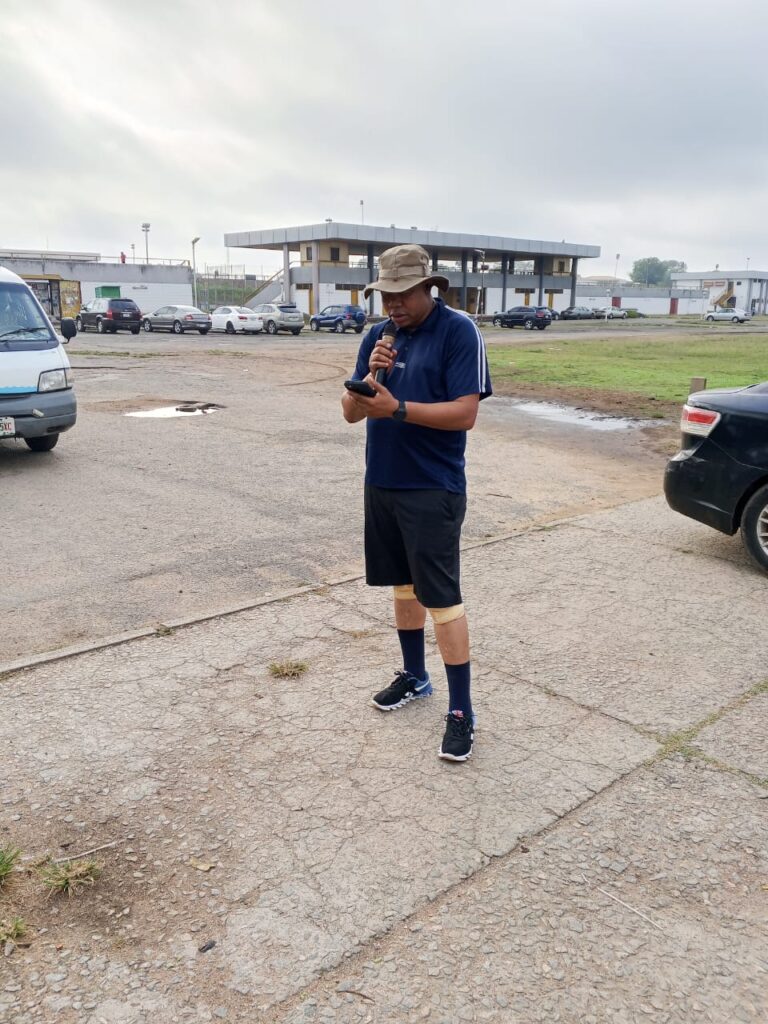
One of the major highlights of the event was a mental health talk delivered by Professor Adesanmi Akinsulore, a renowned mental health expert, who addressed participants during the walk.
Speaking on the fundamentals of mental well-being, Professor Akinsulore explained that mental health extends beyond emotions and encompasses how individuals manage stress from academic, work, financial, and daily life responsibilities. He emphasised three critical factors that shape mental health: ‘How you move, where you live, and how clean and supportive your environment is.’
According to him, physical activity and environmental conditions directly influence mental well-being. He explained that mental health challenges often do not appear suddenly but can begin subtly, with loss of motivation, irritability, constant fatigue, withdrawal from social and academic activities, or feeling ‘off’ without knowing why.
Quoting the World Health Organisation (WHO), he reminded students that health is ‘a state of complete physical, mental, and social well-being, and not merely the absence of disease.’
Professor Akinsulore also outlined the benefits of walking, noting that it reduces stress through the release of endorphins, boosts mood and emotional balance, improves sleep quality, and enhances concentration and academic performance. ‘If you are angry, sad, or overwhelmed, take a walk. You will notice the difference,’ he advised.
He further stressed the importance of a clean environment, describing OAU as a naturally serene campus whose cleanliness can significantly improve mood, encourage movement, enhance social interaction, and promote access to fresh air.
His message to students was clear and repetitive for emphasis: ‘Why not move your body? Why not clean your environment?’
Students’ Union Perspective
At Moremi Hall, the walk paused for an address by the Vice President of the Great Ife Students’ Union, Falade Iyanuoluwa Aanuoluwapo, who spoke passionately about the realities of mental health among students.
She described mental health as more than a ‘fixed’ type of health, explaining that it affects decision-making, productivity, purpose, and even survival. She warned against glorifying constant pressure and hustle without prioritising wellness.
Some of the key points include: the need to balance academics, leadership, volunteering, and personal well-being. Creating time for rest, reflection, and self-awareness. The importance of speaking out and building support systems.
‘Even the best of us, the people we admire, are going through things. Mental health is germane because if you give up, you won’t be able to reach what you’re meant to achieve.’
The Vision Behind the Movement
Speaking to ACJOAU, Daniel Victor, the convener of the Sanity Plus Movement and a Part Four student of Estate Management, explained that the initiative was born out of a long-observed need.
According to him, the idea for Sanity Plus was born from years of observing a troubling pattern on campus. ‘This is a need-based movement. Since my Part One days, we have seen the recurring problem of students breaking down every semester due to mental health-related issues,’ he explained.
Daniel revealed that in several semesters, cases of death linked directly to mental health challenges, particularly suicide, had been recorded, a reality he described as heartbreaking and unacceptable.
‘It’s not fair that there has not been a centralised movement where students who are depressed or going through difficult moments can find awareness, help, and a system that makes them feel seen.’
Beyond mental health, he identified poor sanitation in halls of residence as another persistent issue. Drawing from his personal experience in Angola Hall, he noted that despite the presence of designated cleaners, many hostels remain consistently dirty.
‘So I asked myself, why not create an initiative that combines these two problems, mental health and sanitation? We may not solve everything immediately, but we can begin the process by creating awareness and sparking change.’
Creating Awareness Beyond the Walk
Daniel emphasised that the immediate goal of the Sanity Plus Movement is awareness, which he described as the first step toward lasting change.
‘What we are not aware of, we cannot change. Today’s walk is about helping students identify these issues as real problems that should not be normalised.’
He explained that the movement seeks to reawaken students’ consciousness, encouraging them to see mental health struggles and dirty environments as shared responsibilities rather than isolated or ignorable issues.
‘When you see a student who needs mental support, or you notice dirty surroundings, it should challenge you. These things are not normal, and they shouldn’t be accepted as normal.’
Looking Ahead: Sanity Plus 2.0
Contrary to being a one-off event, Daniel revealed that the Sanity Plus Movement is designed to be continuous and evolving. The initiative is driven by the DC Tribe (Dream Centre OAU), a campus-based impact community.
Plans are already underway for Sanity Plus 2.0, which he described as a bigger and more structured edition. ‘Next year, we are looking at making it bigger and better, involving principal members of the school and key stakeholders. Initiatives like this require strong institutional and community support.’
Plans include partnerships with brands and organisations, as well as specialised cleaning projects across halls of residence, such as tank cleaning and deeper environmental sanitation efforts.
The Team Behind the Movement
Daniel credited the success of the event to teamwork and collective effort. He acknowledged Oreoluwa Oyekanmi, the project manager, alongside other supporting team members, including Dunamis.
He also gave special recognition to the founder of DC Tribe, Dr Akin Akinpelu, for providing the vision and platform that made the initiative possible, as well as Blossom Girls, the movement’s sponsor.
In his closing message to students, Daniel urged participants not to let the impact of the day fade away. ‘Please don’t let the consciousness we’ve created today die. Let this movement move from corporate action to individual responsibility.’
He challenged students to apply what they learned in their daily lives by resisting the urge to litter, correcting others respectfully, and maintaining clean and supportive personal spaces. ‘If there’s one thing I want students to carry forward, it’s to keep the dream and the reason for the Sanity Plus Movement alive in your hearts.’
Voices from the Walk
Participants shared personal reflections on why the movement mattered to them. Olaoye Loveth, a student participant, said her motivation was simple: ‘First, our mental health matters. I also love being part of major events on campus, and this one has been fun and meaningful.’
She added that dirty environments can worsen emotional states, especially when students are already struggling.
Olowo Rafael, a Nursing student and mental health advocate, highlighted the link between sanitation and global development goals: ‘Mental health and cleanliness align with SDG 3 and SDG 6. When your environment is clean, a part of your life is already stable.’
He encouraged students to take responsibility, stressing that change begins with small actions like properly disposing of waste.
Art, Music, and Expression
Adding a creative dimension to the movement, Promise, a spoken word artist, delivered intermittent performances during the walk, using poetry to echo themes of hope, healing, and collective responsibility.
Beyond Today
As the walk concluded, one message echoed throughout the campus: awareness must not end with the event. Organised speakers urged students to carry the consciousness into their daily lives, caring for their minds, supporting one another, and keeping their environment clean.