


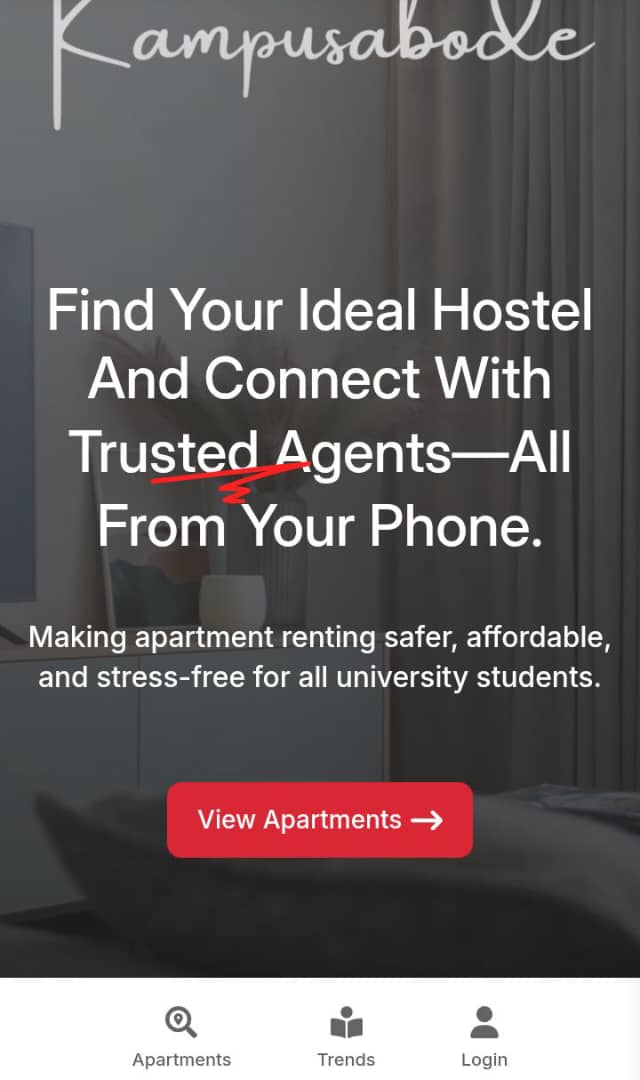
A Part 4 Estate Management student of Obafemi Awolowo University (OAU), Tolulope Ajala, is positioning himself at the intersection of real estate and technology with the launch of Kampus Abode, a student-focused accommodation and services platform designed to address Nigeria’s persistent campus housing crisis.
Ajala, a Part 4 student in the Department of Estate Management, describes himself and his team as deeply passionate about both the tech ecosystem and the creative space. That blend of interests has shaped his entrepreneurial journey, particularly his resolve to apply technology to real-world problems affecting students. Kampus Abode was co-founded with David Eze, Chief Operating Officer (COO), Co-Founder & Marketing Strategist. David is a student of the department of Building, and he develops growth strategies and oversees operations. There is also Okiki Areo, a student of Engineering Physics who serves as the Co-Member & Front-End Developer. He assists in developing and optimising the platform’s user interface.
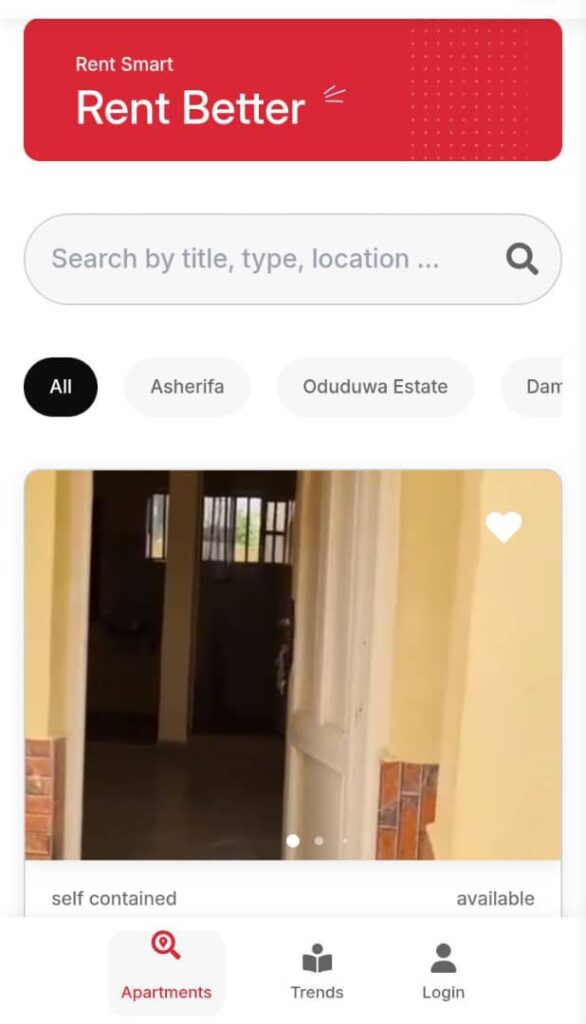
The idea for Kampus Abode emerged from Ajala’s personal experience and market observation. Even before gaining admission into OAU, he was clear about studying Estate Management. However, during the COVID-19 lockdown, he began teaching himself web development, an experience that introduced him to the power of coding as a problem-solving tool.
READ ALSO: BIO 107 Price Reduced as Students’ Union Steps in, Freshmen Commend Union’s Effort
Upon resumption at OAU, Ajala encountered what he describes as a ‘glaring gap’ in the student housing market. With an estimated student population of about 30,000, fewer than 30% can secure on-campus accommodation. This leaves over 21,000 students scrambling for alternatives, often squatting with friends or navigating the risky and unstructured off-campus housing market.
Rather than viewing this as just another campus challenge, Ajala, his co-founder and his team saw an opportunity to innovate. While his decision to build a real estate tech product was not solely influenced by OAU, the university environment provided a concrete problem space where his technical skills could be deployed meaningfully.
Launching Kampus Abode, however, came with its own challenges. Ajala noted that one of the most difficult hurdles was building a committed team. Balancing academics with product development made it hard to find collaborators who shared the same level of passion and vision. Despite this, he says his belief in the idea and his desire to bring it to life kept him resilient through the development phase.
Unlike traditional hostel-finding agents commonly used by students, Kampus Abode is designed as a broader digital ecosystem. True to its name, derived from ‘camp(us) abode’, the platform aims to centralise student needs in one digital space. Beyond accommodation listings, Kampus Abode is being built to provide information, services, and a marketplace tailored to campus life, effectively ‘camping’ students in a unified online abode.
Trust and safety are core to the platform’s operations. Ajala explains that every agent listed on Kampus Abode undergoes physical verification. This includes visiting their offices or accompanying them on inspections to understand how they operate. To further strengthen transparency and fraud prevention, the platform relies on what it calls ‘foot soldiers’ – individuals tasked with on-site inspections and monitoring activities to ensure authenticity and accountability.
Because Kampus Abode serves both students and agents, the platform prioritises information symmetry, ensuring that students, in particular, have access to clear, accurate, and comprehensive details before making housing decisions.
Since its launch, student response has been largely positive. Ajala says the demand for safe and affordable accommodation has driven a high volume of inquiries, presenting both validation and a scaling challenge. The team is now focused on expanding capacity and improving processes to meet growing demand efficiently.
Data also plays a key role in Kampus Abode’s value proposition. The platform leverages hostel reviews and ratings, price comparisons, and detailed information on amenities and services to help students make informed choices. It also fosters a community where students can share experiences, ask questions, and receive peer recommendations. Looking ahead, the team is developing an AI-powered assistant to respond to student queries with speed and accuracy.
In the long term, Ajala envisions Kampus Abode reshaping student housing culture across Nigerian universities. His goal, he says, is to make student life easier by reducing the stress associated with essential needs such as accommodation, information sourcing, and access to everyday services. By creating a unified digital space for students, Kampus Abode aims to allow undergraduates to focus more on their academics and personal development.
While the platform is currently campus-focused, Ajala believes its potential extends far beyond OAU, and even beyond Nigeria. For now, however, he remains committed to taking one step at a time, building a solution that works locally before scaling nationally and globally.